Web3 · Blockchain · UI/UX Design · Next.js Development
Web3 Website Design and Product Development for a Cross-Chain Fee Intelligence Platform
CrossChainIQ is a Web3 platform that answers the question every crypto user asks before moving funds across chains — what will this transfer actually cost, and what arrives on the other side? We took this from UX research through brand identity, product UI design, and full Next.js 14 development — delivering a web3 website design and cross-chain fee intelligence tool built for every user type in the ecosystem.
The Project Behind.
This Case Study
CrossChainIQ is a cross-chain fee intelligence platform built for the entire Web3 ecosystem — from everyday crypto users sending stablecoins between chains to active traders managing positions across multiple L2s and product teams prototyping bridge UX for their own applications. The platform consolidates cross-chain routing options into a single USD-first interface, showing users exactly what a transfer will cost and what they will receive on the destination chain — before they move a single token.
The project was brought to BK Web Designs as a complete product engagement — not a website redesign or a marketing page refresh. The brief covered the full product build: UX research, competitive analysis, brand identity, information architecture, visual design system, product UI, web design, CRO strategy, accessibility implementation, and Next.js development. Everything from the first research session to the deployed codebase was delivered under one engagement.
This web3 website design and product development case study documents that full process — from synthesising patterns across six competing tools to shipping a production-ready open source platform with a documented component system and clean Next.js 14 architecture.
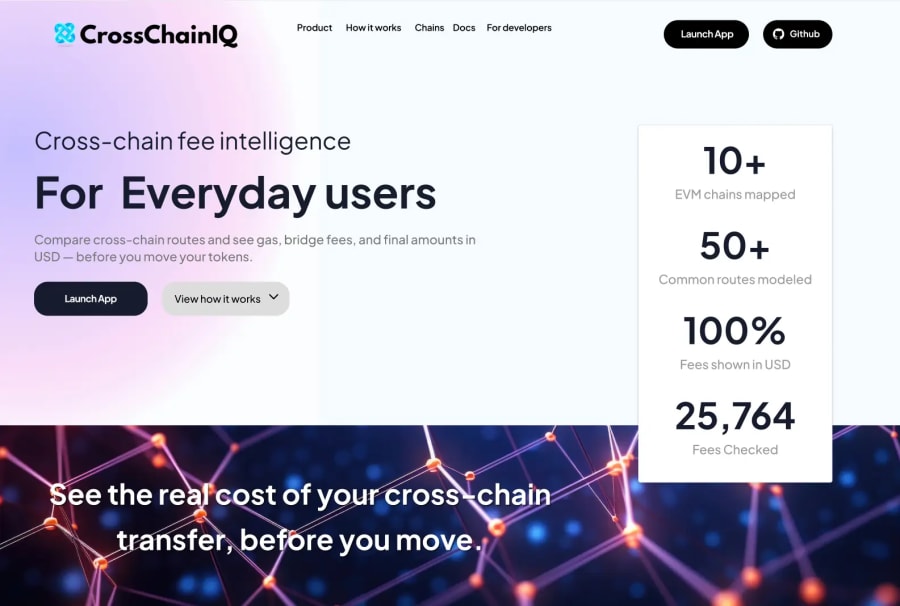
Cross-Chain Transfers Are Expensive, Confusing, and Completely Opaque - Until Now
Anyone who has moved tokens across chains knows the feeling. You open a bridge, enter an amount, and somewhere between the gas fee estimate, the bridge liquidity fee, the slippage warning, and the “you will receive approximately” figure that nobody explains — you lose track of what you are actually paying and what will actually arrive. You either proceed and hope for the best, or you open four other tools and try to calculate it manually.
This is not a niche problem. It is the daily reality for every active Web3 user — and it has remained unsolved despite years of infrastructure development in the cross-chain space. The data exists. The chains are mapped. The routing protocols are mature. The missing piece is a clean, USD-first interface that consolidates all of that information into a single human-readable view before the user commits to a transaction.
CrossChainIQ was built to be that interface. But building it required solving several compounding design and development challenges simultaneously.
The Existing Tools Were Built for Engineers, Not Users
Competitive analysis of the leading cross-chain tools — Lido, Stargate, Hop, Across, Etherscan, GasNow — revealed a consistent pattern. Every tool that handled cross-chain fee data well was designed with technical users as the primary audience.
Raw numbers without USD context. Multiple interfaces requiring manual switching between chains. Fee breakdowns buried behind secondary navigation. These tools are powerful for developers and largely inaccessible for the everyday crypto user moving stablecoins between chains.
Three Completely Different User Types, One Interface
CrossChainIQ needed to serve everyday crypto movers checking transfer costs, active traders comparing routes across multiple L2s, and product teams prototyping bridge UX — from the same interface, without configuration.
Designing for one of these user types at the expense of the others would have replicated the exact problem the platform was built to solve.
USD-First Display Across Complex Fee Structures
Cross-chain transfer costs are not a single number. They are a combination of network gas, bridge liquidity fees, slippage estimates, and destination chain costs — each denominated differently and changing with every block.
Presenting all of that as one clear USD total — what you send, what you pay, what arrives — required both a UX architecture and a routing engine that did not exist as an off-the-shelf solution.
Brand Identity From Zero in a Crowded Visual Space
The Web3 design space has a visual language problem. Most crypto products default to the same dark mode, neon gradient, abstract node aesthetic — creating a market where every product looks like every other product.
CrossChainIQ needed a visual identity that felt native to Web3 without being indistinguishable from the category noise.
💡 The cross-chain fee problem is not a technical problem — the data exists and the protocols work. It is a design problem. The tool that wins is the one that makes the cost of a transfer readable in under five seconds, without requiring the user to understand how bridges work.
A Full-Stack Web3 Product Needs
One Team Across Research, Design, Brand, and Development.
The scope of CrossChainIQ ruled out the standard multi-vendor approach from the start. UX research that informs information architecture that informs brand identity that informs component design that informs Next.js development — that chain of decisions only holds together when one team owns it end to end. Hand any part of it to a separate vendor and the translation loss compounds at every stage.
UX Research Before Any Screen Was Drawn
We began with structured competitive analysis — not opinions about what the interface should look like.
Synthesising patterns across Lido, Stargate, Hop, Across, Etherscan, and GasNow gave us a clear picture of what the category was getting wrong and where CrossChainIQ had genuine design space to differentiate. Research drove every architecture decision that followed.
Brand Identity Built for Web3 Without Looking Like Every Other Web3 Product
The CrossChainIQ visual identity — primary #6e54ff, accent #11FFE5, dark background #161C2D, and Plus Jakarta Sans typography — was crafted to communicate clarity, trust, and technical sophistication.
Abstract network and flow visuals replaced overused coin and exchange icons, giving this crypto website design a modern, Web3-native feel without blending into the category.
Next.js 14 Development That Matched the Design System Exactly
The gap between a Figma design and a working Next.js implementation is where most Web3 product quality is lost. We closed that gap by building the component system in Figma with the TypeScript and Tailwind implementation in mind — so the development phase was execution, not interpretation.
Every component state, every loading condition, every responsive behaviour was designed before a line of code was written.
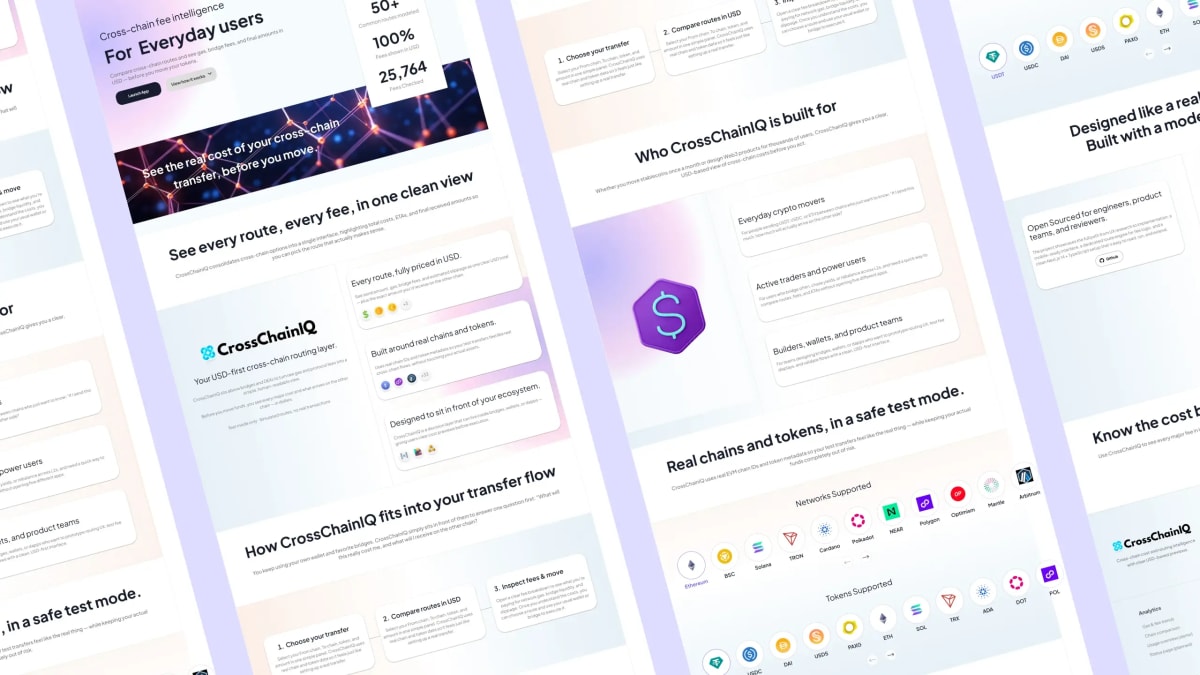
Research First. Story Second.
Interface Third.
The UX strategy for CrossChainIQ was built on one research insight that changed everything: users scan cross-chain interfaces top to bottom looking for what, why, how, who, and then proof — in that order.
Every existing tool in the category ignored this sequence and presented everything simultaneously. CrossChainIQ was designed around the sequence.
Since 2014
Web3 Design Specialists
50+ Countries
Experienced Specialists
60-Day Delivery
4.9/5 Rating (612 Reviews)
Phase 1 — UX Research and Competitive Analysis
We synthesised interaction patterns from six competing tools — Lido, Stargate, Hop, Across, Etherscan, and GasNow — mapping where each tool created confusion for non-technical users and where experienced traders lost efficiency. Three consistent failure patterns emerged: no USD-first display, no consolidated multi-chain view, and no scroll narrative that built understanding progressively.
These three patterns became the core UX brief for CrossChainIQ — and they explain why strong analytics dashboard design always starts with competitive research rather than a blank Figma canvas.
Phase 2 — Information Architecture and Scroll Strategy
The information architecture was designed around a sectioned storytelling model — hero answers what and why in under five seconds, then value proposition, explanation, how it works, who it serves, supported networks, technical stack, and proof. Each scroll stop focused on one idea, reducing cognitive load at every stage.
Sticky blocks kept key explanations in view while details scrolled beside them — a pattern borrowed from Lido and refined for CrossChainIQ’s specific information hierarchy. Scroll checkpoints were designed with clear exit actions: Launch App, See How It Works, View GitHub.
Phase 3 — Brand Identity and Visual System
The CrossChainIQ brand identity was built from scratch — logo system, colour palette, typography, component style guide, and imagery direction. The primary purple (#6e54ff) communicates trust and technical innovation.
The teal accent (#11FFE5) drives CTAs and interactive elements. The dark background (#161C2D) creates focus zones and reduces fatigue during extended sessions. Plus Jakarta Sans was selected for its clarity at both display and body sizes — readable at 64px hero headings and 15px body copy without visual compromise.
Abstract network nodes, flow lines, and soft gradient glows replaced literal crypto imagery throughout.
Phase 4 — UI Design, CRO, and Accessibility
The UI was designed with one primary CTA — Launch App — repeated at every key decision point in the scroll. Secondary CTA — View Code on GitHub — positioned for the developer and product team audience. Benefits were grouped into three to four focused cards rather than feature lists, keeping scanning fast.
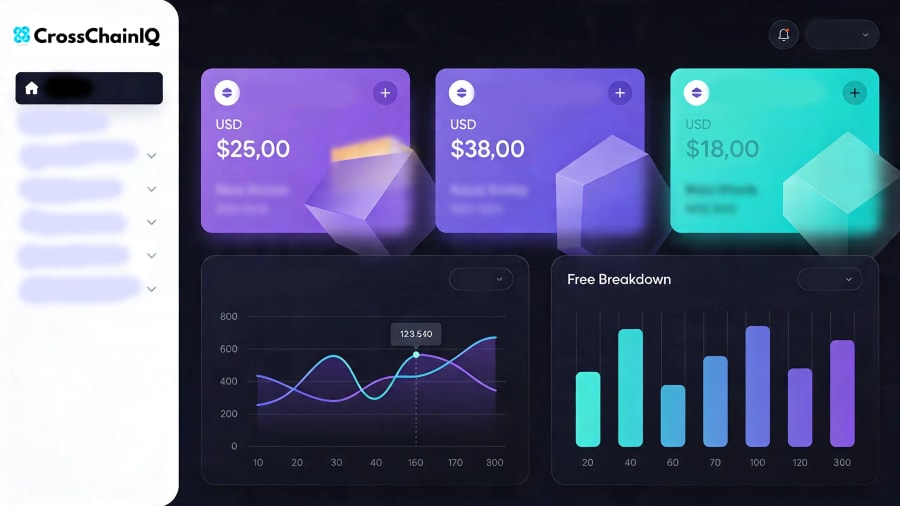
The app preview section was placed before the final CTA to bridge the gap between product pitch and real interface. Accessibility was built into the design system — high contrast text on all backgrounds, USD amounts and key labels visually prominent, layout using predictable grid patterns that adapt cleanly to mobile, CTAs distinguishable by colour and shape rather than colour alone.
Phase 5 — Next.js 14 Development and Component Implementation
The full platform was built on Next.js 14 App Router with React 18, TypeScript for all domain models, Tailwind CSS for consistent UI, and Framer Motion for subtle scroll-aware microinteractions. The routing engine — a dedicated routeEngine module — simulates cross-chain routes and fees using real EVM chain IDs and token metadata, making test transfers feel like real cross-chain flows without touching actual assets. Mock APIs are deterministic for predictable demos.
The codebase was structured for open source community extension — clean separation between UI and calculation logic, easy to plug into real bridge APIs when the platform moves beyond test mode. Web dashboard design built on this architecture scales with community contribution without requiring design team involvement for every new feature addition.
What We Intentionally Left Out.
We did not design for power users first. Every existing cross-chain tool makes this mistake — building for the most technical user in the room and leaving everyone else to figure it out. CrossChainIQ was designed normie-first, USD-first — with every advanced feature accessible through progressive disclosure rather than front and centre in the default view.
A DeFi trader can drill into protocol-level fee breakdowns. A first-time user sees what they send, what it costs, and what arrives. The complexity exists. It just does not dominate.
Six Workstreams. One Complete Web3 Product.
From Research to Deployed Codebase.
Every web3 website design and product build we deliver starts with one question — what does the user need to understand, and in what order?
For CrossChainIQ, six parallel workstreams answered that question across research, brand, UI, accessibility, development, and conversion — delivered as one integrated product launch. Here is exactly what we built and why each decision was made.
UX Research and Competitive Analysis
Built to Understand What the Category Gets Wrong Before Designing Anything Right
Structured analysis of Lido, Stargate, Hop, Across, Etherscan, and GasNow mapped the interaction patterns, information hierarchies, and failure points of every major cross-chain tool in the market.
The research identified the core UX problems — no USD-first display, chain-switching context loss, fee data buried in secondary interfaces — and established the design brief that every subsequent decision was built around. Research before screens means no wasted design cycles and no features built for assumptions that competitive analysis would have disproved.
Brand Identity and Visual System
Built to Feel Web3-Native Without Looking Like Every Other Crypto Product
The CrossChainIQ brand identity was built from zero — logo system, colour palette, typography selection, component style guide, button system, card design, icon direction, background motion language, and imagery guidelines.
The visual identity communicated clarity and technical precision without defaulting to the neon-heavy aesthetic that makes most crypto products visually indistinguishable. Abstract network nodes and flow imagery, soft purple and teal gradients on dark backgrounds, and minimal line-art icons created a product aesthetic that felt simultaneously modern, trustworthy, and genuinely Web3-forward.
Information Architecture and Product UI Design
Built Around the Scroll Sequence That Matches How Web3 Users Actually Think
The product landing page and app interface were designed around a documented scroll narrative — hero answers what and why in under five seconds, then progressive deepening through value, mechanism, user types, supported networks, technical stack, and proof. Sticky left-column blocks kept explanations in view while detail content scrolled beside them.
Each section focused on one idea. CRO tactics were embedded throughout — concrete outcome language over abstract DeFi terminology, grouped benefit cards over feature lists, app preview before final CTA, and one primary action repeated at every scroll checkpoint.
Accessibility and Mobile Experience
Built for Every User on Every Device Without Compromise
Accessibility was a design system requirement, not a post-launch audit item. High contrast text across all background types, USD amounts and key labels visually prominent, layout patterns predictable and consistent across screen sizes, CTAs distinguishable by colour and shape rather than colour alone, DeFi jargon either removed or contextually explained in secondary copy.
Mobile behaviour mirrored the desktop scroll logic — same story order, stacked and chunked for thumb-friendly reading, with no features hidden or degraded on smaller screens.

Next.js 14 Development and Routing Engine
Built With a Modern Production Stack Ready for Open Source Community Extension
The full platform was developed on Next.js 14 App Router with React 18, TypeScript across all domain models, Tailwind CSS for rapid consistent UI, and Framer Motion for product-grade scroll-aware microinteractions. The dedicated routeEngine module simulates cross-chain routes and fees using real EVM chain IDs and token metadata — 10+ chains, 50+ routes modelled, deterministic mock APIs for predictable demos.
Safe test mode keeps the platform review-friendly and onboarding-safe with no on-chain calls or wallet signatures required. The codebase was structured for clean community extension — clear separation between UI and calculation logic, easy integration with real bridge APIs when the platform moves to production execution.

CRO Strategy and Conversion Architecture
Built to Turn a Web3 Tool Into a Product That Users Actually Launch and Return To
Conversion rate optimisation for a Web3 open source tool is different to ecommerce CRO — the conversion event is app launch and GitHub engagement, not a purchase. The CTA architecture was designed around two actions: Launch App as the primary conversion and View Code on GitHub as the secondary.
Social proof elements — supported chains, token count, fees checked counter, stack transparency — were positioned to reduce perceived risk and increase trust at the decision point. The inside-the-app preview section was placed specifically to bridge the gap between the product pitch and the actual interface before the final CTA appeared.
Services Delivered in This Project.
This crypto website design and product development engagement required the full spectrum of our capabilities — running simultaneously under one brief.
UX research informed the brand. The brand informed the UI. The UI informed the Next.js architecture. Every service below was part of one connected system, not a collection of separate deliverables handed between vendors.
UX designed for non-technical crypto users and experienced DeFi builders
Explore UI/UXA web3 website design built to explain cross-chain fees with clarity
Explore Web DesignA launch-ready visual identity built for trust in a crowded web3 market
Explore BrandingPerformance-focused frontend development for a scalable cross-chain product
Explore Web DesignWeb3 Website Design Results:
A Production-Ready Cross-Chain Platform Built From Research to Deployed Codebase.
CrossChainIQ is in active development ahead of its open source public launch.
For a web3 website design and analytics dashboard design engagement of this scope — covering research, brand, UI, and full Next.js development — results are measured in product completeness and system quality, not traffic or revenue metrics.
Here is what was built and what it delivers.
No brand identity, no design system, no visual language for the platform
Complete CrossChainIQ brand identity — colour system, typography, component library, imagery direction, and usage guidelines
No information architecture — product vision without a user experience model
Full scroll-based UX narrative designed around the documented what-why-how-who-proof sequence
Cross-chain fee data requiring users to open multiple tools and calculate manually
Single USD-first interface consolidating routes, gas, bridge fees, and received amounts in one clean view
No accessible design — technical crypto interface built for experienced users only
Accessibility-first design system with high contrast, predictable layouts, and jargon-reduced copy across all user types
No development architecture — design without implementation
Full Next.js 14 production codebase with TypeScript, Tailwind CSS, Framer Motion, and dedicated routeEngine module — open source ready
No CRO strategy — product with no conversion architecture
Documented CRO framework with primary and secondary CTA hierarchy, social proof placement, and app preview conversion bridge
The Multiplier Effect
Results reflect design, brand, and development deliverables for an active development project. Platform growth metrics will be documented post-launch.
What This Means For You.
If you are building a Web3 product — a cross-chain tool, a DeFi interface, a wallet application, a blockchain analytics platform, or any data-heavy crypto product — the pattern in this case study applies directly to your brief.
Web3 products consistently make one structural mistake: they begin with development and apply design afterwards. The engineering gets built first, the interface gets layered on top, and the result is a technically capable product that real users cannot navigate without prior knowledge of how the underlying protocols work.
This is not a talent problem. It is a sequence problem. Design that follows development is always constrained by architectural decisions made without UX input.
CrossChainIQ was built in the correct sequence — research, then architecture, then brand, then UI, then development. Every decision in the codebase was preceded by a design decision. Every design decision was preceded by a research finding.
The result is a platform where the technical capability and the user experience are aligned rather than in tension — and that alignment is only possible when dashboard ux design decisions are made before the development architecture is locked, not after.
If you are at any stage of a Web3 product build — pre-design, mid-development, or post-launch with a UX problem you cannot solve — a free audit of your current brief or product is the right starting point. We will tell you exactly where the sequence broke down and what it will take to fix it.
"CrossChainIQ proved something the crypto space keeps learning the hard way — the tool that wins is not the one with the most data. It is the one that makes the data readable in under five seconds.
Every design decision we made, from the scroll architecture to the USD-first display to the component system, was in service of that single outcome."
— Director, BK Web Designs
Customer Testimonial.
CrossChainIQ is an open source Web3 platform currently in active development. A full client testimonial will be published at product launch. If you are building a Web3 product and want to discuss the research, design, and development approach used in this engagement, book a free strategy call with our team.
More Work Like This.


Project FAQ
Questions about this project or how a similar engagement could work for your business.
How much does Web3 website design and product development cost for a crypto or blockchain platform?
A full Web3 website design and product development engagement — covering UX research, brand identity, information architecture, UI design, accessibility, CRO, and Next.js development — typically ranges from $8,000 to $25,000 depending on scope and product complexity.
A focused web3 design agency engagement covering just the landing page design, brand identity, and front-end development runs from $5,000 to $12,000. CrossChainIQ represented a full-scope product engagement covering every layer from research to deployed codebase.
We provide itemised transparent pricing after a free discovery call — every recommendation is tied to a specific product or conversion outcome before you commit.
Why does UX research matter for a Web3 product before any design work begins?
Web3 products fail at the interface level far more often than at the technical level. The protocols work. The data is available. What breaks is the experience layer — because most Web3 teams begin with development and apply design afterwards.
UX research before design means every information architecture decision is grounded in how real users actually think about cross-chain transfers, DeFi positions, or wallet analytics — not how engineers think about the underlying data structures.
For CrossChainIQ, competitive analysis of six tools identified three consistent failure patterns that became the entire UX brief. That research prevented months of design iterations chasing the wrong problems.
What is the difference between designing a Web3 marketing website and a Web3 product interface?
A Web3 marketing website — sometimes called a crypto website design or project landing page — is designed to explain what the product does, who it is for, and why it matters, with a primary conversion goal of driving users to launch the app, connect a wallet, or join a community.
A Web3 product interface is the actual tool users interact with — dashboards, routing panels, fee comparisons, wallet views. CrossChainIQ required both: a landing page built around the documented scroll narrative and CRO framework, and a product interface built around the USD-first routing engine and multi-chain data model. Both were designed and developed under one engagement.
How do you handle accessibility in a Web3 or crypto product design?
Accessibility in Web3 design is consistently deprioritised — and consistently punishes the products that ignore it. High contrast text on dark backgrounds, USD-denominated amounts visually prominent over raw fee data, layout patterns predictable across screen sizes, CTAs distinguishable by shape and colour rather than colour alone, DeFi terminology either removed or contextually explained in secondary copy.
For CrossChainIQ, accessibility was a design system requirement built into every component — not an audit conducted after the interface was complete. The result is a platform usable by everyday crypto users without prior DeFi knowledge, alongside experienced traders who need protocol-level detail.
Can you build a Web3 product designed for open source community contribution?
Yes — and it requires a specific approach to both design system documentation and development architecture that most agency engagements skip. An open source Web3 product needs a component library documented with usage guidelines and state variations so community contributors can build new features without breaking visual consistency.
It needs a codebase structured with clean separation between UI and business logic so contributors can extend one without understanding the other. CrossChainIQ was designed and built with these requirements as first-class constraints — the Figma component library maps directly to the TypeScript React components, and the routeEngine module is isolated from the UI layer for clean community extension.
About This Project
This case study documents a web3 website design and full product development engagement delivered by BK Web Designs for CrossChainIQ — a cross-chain fee intelligence platform built to make the real cost of token transfers readable in USD before a single transaction is executed. The engagement covered the complete product build: UX research and competitive analysis across six leading cross-chain tools, brand identity and visual system, information architecture and scroll strategy, product UI design, accessibility implementation, CRO framework, and Next.js 14 front-end development with a dedicated cross-chain routing engine.
Web3 website design for data-heavy crypto and blockchain products requires a fundamentally different approach to standard SaaS or marketing website design. The underlying data model — real-time, multi-chain, structurally complex — demands information architecture decisions that standard UI patterns cannot handle without creating the cognitive overload that makes every existing cross-chain tool frustrating for non-technical users.
CrossChainIQ was designed around a documented scroll narrative — what, why, how, who, then proof — borrowing proven sticky-block patterns from Lido and Monad and elevating them with a USD-first information hierarchy that no existing crypto analytics tool had implemented cleanly. This web3 design agency approach — research before screens, architecture before aesthetics — is the difference between a Web3 product that users launch and one they abandon after the first confused scroll.
The crypto website design and brand identity system for CrossChainIQ was built from zero — primary purple #6e54ff communicating clarity and trust, teal accent #11FFE5 driving interactive elements and CTAs, dark background #161C2D creating focus zones for extended session usage, Plus Jakarta Sans typography for readability across display and body sizes. Abstract network node imagery and soft gradient glows replaced the literal coin and exchange iconography that makes most Web3 products visually indistinguishable. The visual identity felt native to the Web3 ecosystem without defaulting to the category aesthetic noise that undermines brand recognition across the space.
The analytics dashboard design and routing engine were built on Next.js 14 App Router with React 18, TypeScript, Tailwind CSS, and Framer Motion — a modern production stack structured for open source community extension from day one. The dedicated routeEngine module simulates cross-chain routes and fees using real EVM chain IDs and token metadata across 10+ chains and 50+ modelled routes, with deterministic mock APIs for predictable demos and a safe test mode that requires no on-chain calls or wallet signatures. Dashboard ux design built with real data structures in mind — not curated mock data — holds up under live conditions in ways that design-first-development-later products consistently fail to achieve.
BK Web Designs has delivered web3 website design, crypto platform UI/UX, brand identity, and React and Next.js product development for blockchain projects and Web3 startups across 50 countries since 2014. If you are building a crypto analytics tool, a DeFi interface, a cross-chain product, or any data-heavy Web3 application that needs research, design, brand, and development delivered as one integrated engagement — a free project audit is the right starting point.
Services: Web3 website design · Crypto website design · Analytics dashboard design · Brand identity · UI/UX design · Information architecture · UX research · CRO strategy · Accessibility · Next.js development · React development · Open source product design
Industry: Web3 · Blockchain · Cross-chain infrastructure · DeFi · Crypto · EVM · Open source · Fintech
Platform: Next.js 14 · React 18 · TypeScript · Tailwind CSS · Framer Motion · EVM chains · Open source
Markets: Global · Web3 ecosystem · Crypto startups · DeFi protocols · Blockchain developers · Institutional analysts · Open source community
Limited Availability (Here's Why)
We take 6 new projects per month maximum. Quality conversion optimization can't be rushed.
Ready
to Start Your Blockchain Project?
Tell us about your business and goals. We’ll send you:
✓ Estimated timeline
✓ Transparent pricing
✓ Similar case studies
✓ Next steps
🔒 Your information is confidential
⚡ Response within 24 hours (usually 4 hours)